
When seeds change hands: gender, intersectionality, and access to seed in rural Senegal
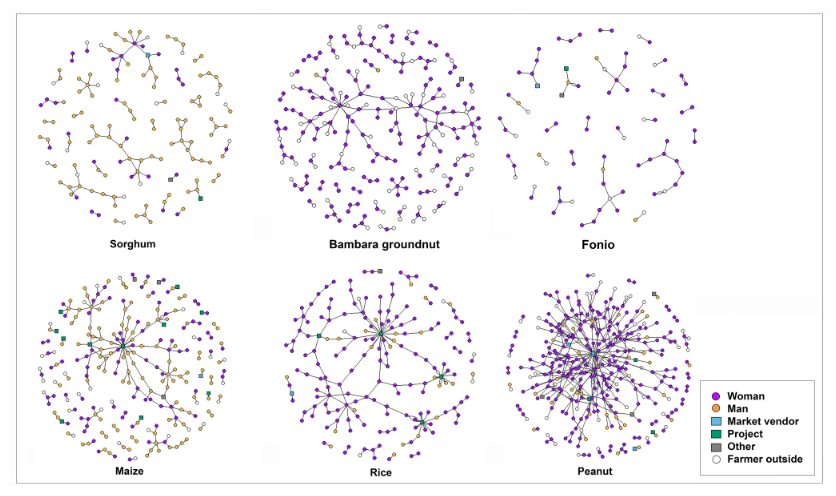
Despite advances in understanding seed circulation in rural communities, little is known about the gendered and intersectional power relations that shape farmers’ access to seed. Based on a case study in a Bassari community of southeastern Senegal, we examine the roles of women and men in seed circulation and explore who maintains and who controls access to seed for six staple crops. Combining ethnographic data with social network analysis, we show that gender roles in seed circulation are dynamic: some crops traditionally managed by men are entering women’s hands, expanding women’s custodial role for subsistence crops, while some crops historically managed by women are increasingly mediated by external actors who redirect them toward men, potentially undermining women’s control and creating new dependencies. Our findings also show that gender alone does not explain farmers’ positions as seed access maintainers or controllers. Rather, gender intersects with age, wealth, marital status, and other forms of social difference to structure patterns of seed access maintenance and control. These dynamics vary across crops, revealing how crop’s local meanings, trajectories and political entanglements shape seed access. Drawing on feminist political ecology, we discuss how shifting gender roles create opportunities and exclusions for different groups of women and men. By tracing how seeds change hands, this study highlights the importance of intersectional and situated approaches for understanding seed access inequalities. Ensuring equitable access to locally adapted and culturally appropriate seeds is not only a matter of justice but also a means of safeguarding agrobiodiversity.
Livelihood resilience: The role of social-ecological filters in a Globally Important Agricultural Heritage System of southern Chile
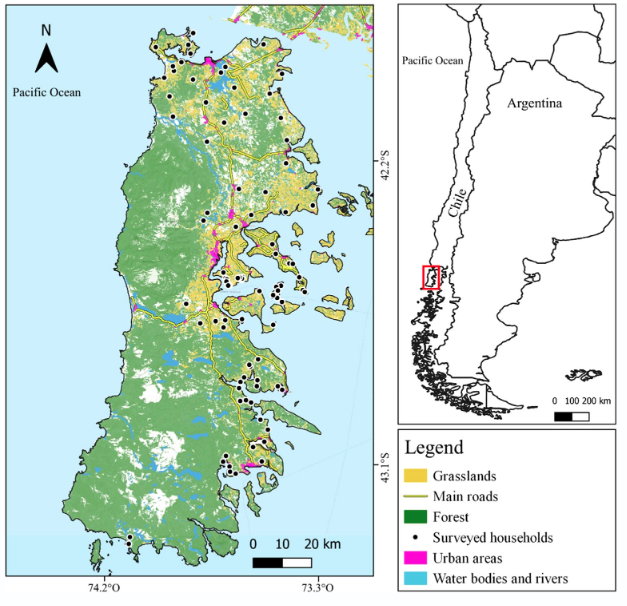
1. The global agrifood system faces significant threats due to rapid and interconnected social-ecological changes, including climate change, land-use shifts, demographic changes and emerging diseases. Small-scale farmers are among the most vulnerable groups to these changes due to their direct dependence on their environment.
2. The resilience of small-scale farming livelihoods may be influenced by several social-ecological filters, which are the coupled human–nature factors that could either hinder or increase resilience, directly impacting local agrifood systems. Our study aims to assess how different social-ecological filters (i.e. sociodemographic factors, diversity of agroecosystems and on-farm landscape composition), operating at multiple levels, are associated with small-scale farmers’ livelihood resilience in the Chiloé Archipelago, a Globally Important Agricultural Heritage System within a Global Biodiversity Hotspot in southern Chile.
3. We conducted 100 household surveys with small-scale farmers to calculate the diversity of agroecosystems within each farm and an Index of Livelihood Resilience (ILR) based on indicators of five capital assets (i.e. social, physical, natural, financial and human). We also took aerial photographs of their farms, from which we derived information on landscape composition. Using Generalized Linear Mixed Effects Models, we tested the association between eight different social-ecological filters and the ILR.
4. We found that the age of the household head and shrubland surface in the farm were negatively associated with livelihood resilience, while the diversity of agro-ecosystems within the farms was positively associated with the livelihood resilience of small-scale farmers.
5. Identifying factors that enhance the livelihood resilience of small-scale farmers is essential for developing effective initiatives and policies aimed at ensuring global and local food security and sovereignty. Based on our results, we propose recommendations to strengthen small-scale farmers’ livelihood resilience to mitigate the global agrifood crisis.
High life satisfaction reported among small-scale societies with low incomes
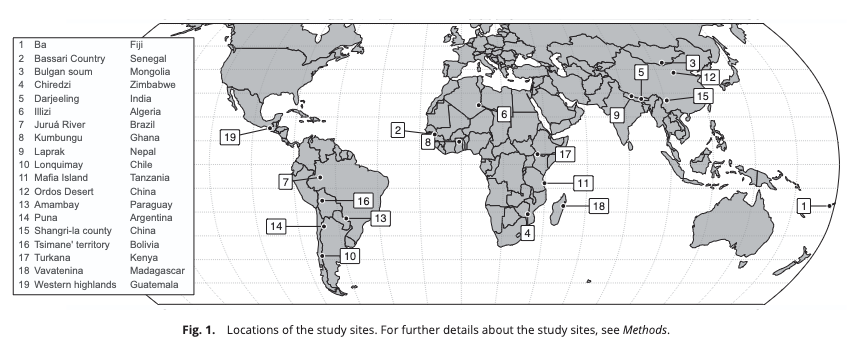
Global polls have shown that people in high-income countries generally report being more satisfied with their lives than people in low-income countries. The persistence of this correlation, and its similarity to correlations between income and life satisfaction within countries, could lead to the impression that high levels of life satisfaction can only be achieved in wealthy societies. However, global polls have typically overlooked small- scale, nonindustrialized societies, which can provide an alternative test of the consistency of this relationship. Here, we present results from a survey of 2,966 members of Indigenous Peoples and local communities among 19 globally distributed sites. We find that high average levels of life satisfaction, comparable to those of wealthy countries, are reported for numerous populations that have very low monetary incomes. Our results are consistent with the notion that human societies can support very satisfying lives for their members without necessarily requiring high degrees of monetary wealth.
Indigenous and local knowledge on social-ecological changes is positively associated with livelihood resilience in a Globally Important Agricultural Heritage System
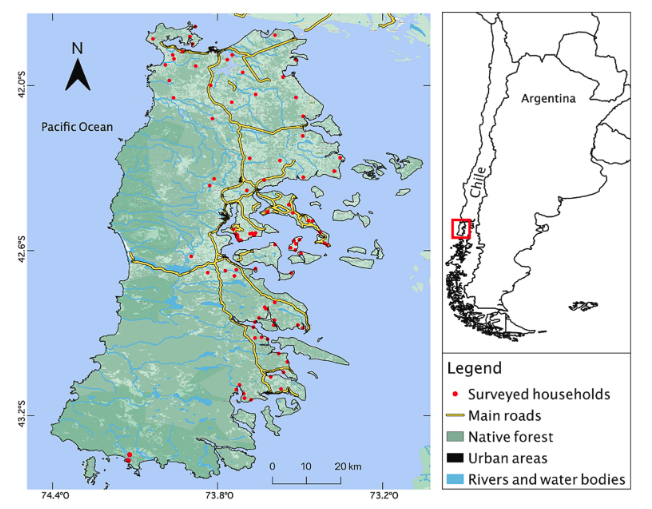
Rapid social-ecological changes such as climate change, biodiversity loss, and resource overexploitation are threatening food security, livelihoods, and local knowledge of small-scale farmers worldwide. There has been a call from scientists, farmers, and activists to identify and promote the mechanisms for sustaining resilient farming livelihoods. We hypothesize that small-scale farmers who are more knowledgeable about changes in their environment are more resilient to current social-ecological changes as they might be more prepared to respond to these disturbances.
Crop biocultural traits shape seed networks: Implications for social-ecological resilience in south eastern Senegal
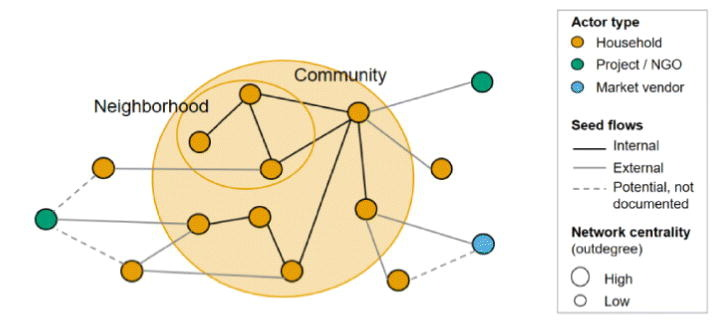
Agroecosystems’ social-ecological resilience largely depends on the crop diversity generated and maintained by farmers, which provides insurance against changing environmental and socio-economic conditions. In turn, crop diversity generation, maintenance, and distribution is influenced by seed circulation networks. Thus, patterns of seed circulation can support or constrain households’ access to crop diversity, affecting on-farm crop diversity.