
Tracking pesticides from upstream plantations to native bivalves in a tropical wetland habitat in Costa Rica
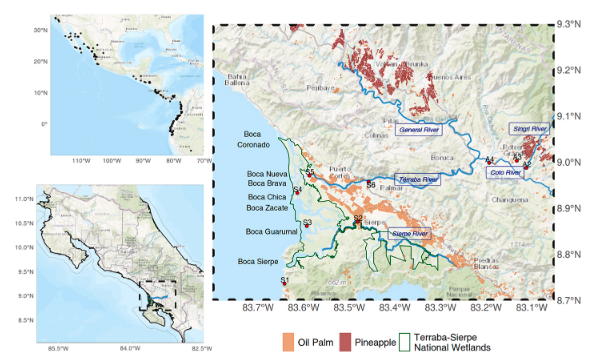
Mangrove forests are highly productive tropical and subtropical ecosystems providing ecosystem services and supporting local livelihoods, while being influenced by contamination both from land and sea. In the tropics, high temperatures and humidity increase crop susceptibility to pests and pathogens, requiring more frequent pesticide use and raising contamination risks. Costa Rica serves as a key case study, exemplifying the challenges of pesticide management in tropical regions characterized by intensive agriculture. This study identified and quantified pesticide residues in water and sediment samples in the Térraba-Sierpe National Wetland and influence areas. To determine pesticide exposure and its effects, the native bivalve mollusc Anadara tuberculosa was selected as a bioindicator species. Results evidenced the presence of pesticides in the Térraba River waters, the northern Térraba-influenced wetland area, as well as in A. tuberculosa, with diuron, carbendazim, diazinon, and ethoprophos appearing at the highest concentrations in water. Moreover, glutathione S-transferase, cholinesterase, and ethoxyresorufin-O-deethylase biomarkers showed statistically significant differences with a control site (p < 0.05). Considering the geographical distribution of these substances and their utilization in pineapple cultivation, there was a plausible association between this agricultural activity and the observed impact on the wetland aquatic environment. The study supports the potential of A. tuberculosa biomarkers, particularly glutathione S-transferase and cholinesterase activities, to investigate pesticide effects in coastal systems potentially affected by pesticide contamination, develop environmental monitoring and inform pesticide regulations.
Antarctic phytoplankton community composition and size structure: importance of ice type and temperature as regulatory factors

Climate change at the Western Antarctic Peninsula (WAP) is predicted to cause major changes in phytoplankton community composition, however, detailed seasonal field data remain limited and it is largely unknown how (changes in) environmental factors influence cell size and ecosystem function. Physicochemical drivers of phytoplankton community abundance, taxonomic composition and size class were studied over two productive austral seasons in the coastal waters of the climatically sensitive WAP. Ice type (fast, grease, pack or brash ice) was important in structuring the pre-bloom phytoplankton community as well as cell size of the summer phytoplankton bloom. Maximum biomass accumulation was regulated by light and nutrient availability, which in turn were regulated by wind-driven mixing events. The proportion of larger-sized (> 20 µm) diatoms increased under prolonged summer stratification in combination with frequent and moderate-strength wind-induced mixing. Canonical correspondence analysis showed that relatively high temperature was correlated with nano-sized cryptophytes, whereas prymnesiophytes (Phaeocystis antarctica) increased in association with high irradiance and low salinities. During autumn of Season 1, a large bloom of 4.5-µm-sized diatoms occurred under conditions of seawater temperature > 0 °C and relatively high light and phosphate concentrations. This bloom was followed by a succession of larger nano-sized diatoms (11.4 µm) related to reductions in phosphate and light availability. Our results demonstrate that flow cytometry in combination with chemotaxonomy and size fractionation provides a powerful approach to monitor phytoplankton community dynamics in the rapidly warming Antarctic coastal waters.
The craving for phosphorus in heterotrophic dinoflagellates and its potential implications for biogeochemical cycles

By altering the nutritional quality of primary producers, nutrient availability indirectly influences herbivores’ population dynamics. In turn, the resulting relationship between diet, growth, and wastes has consequences for nutrient cycling at the ecosystem level. We studied the link between dinoflagellates nutritional requirements and feeding behavior, and its influence on nutrient cycling. We show that long-term shifts in dissolved PO4 concentration in the North Sea are closely linked to biomass trends of heterotrophic dinoflagellates and support this observation with experimental data indicating particularly high phosphorus requirements in dinoflagellates. At the seasonal scale, we observe a negative correlation between natural dinoflagellate abundances and the concentration of dissolved P, and we estimate that, in spring, up to 30% of dissolved P can end up in microzooplankton biomass. Our study highlights that accounting for organismal metabolic requirement provides significant insight in interpreting and predicting nutrient cycles at the ecosystem level.
Winter river discharge may affect summer estuarine jellyfish blooms
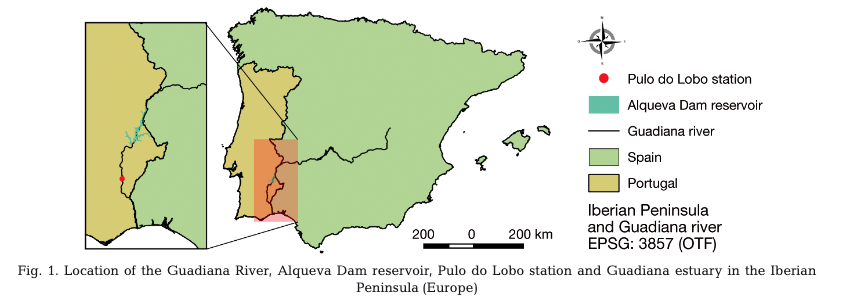
Dams alter the natural dynamics of river inflow, disrupting biological processes in downstream ecosystems, as observed in the Guadiana estuary (SW Iberian Peninsula, Europe). Here, significant interannual fluctuations in the densities of jellyfish occur during summer, likely due to changes in winter river discharge. Therefore, this study aimed to quantify the relationship between winter river inflow and the abundance of jellyfish in the Guadiana estuary. In addition, the budding and growth of Aurelia aurita polyps, one of the bloom-forming species present in the estuary, were determined at different combinations of constant temperature and salinity. The response of polyps and ephyrae to short-term, low-salinity pulses was also quantified. Maximum winter river discharge and maximum abundance of estuarine medusa (bloom indicator) showed a significant negative correlation. Under constant conditions, polyps showed increased mortality when water temperature was higher than 23°C and salinity was lower than 23, and died when exposed to a short-term, low-salinity pulse (≤3). After exposure to freshets, polyp budding and feeding rates decreased by 69% and 32%, respectively, when salinity reached values as low as 10. Ephyrae died when salinity was lower than 10, and feeding rates decreased by 88% when salinity was 17, compared with full marine conditions. In conclusion, winter freshwater discharge may regulate the strength of estuarine jellyfish blooms, impairing the survival or condition of polyps and ephyrae during late winter or early spring. River basin managers should consider the prescription of freshets to prevent jellyfish blooms from disrupting ecosystem services (e.g. fisheries, tourism).
Chlorophyll in North Sea coastal and offshore waters does not reflect long term trends of phytoplankton biomass

This study analyses long-term and seasonal changes of phytoplankton community Carbon: Chlorophyll a ratio (θ) during the period 1991 to 2010 in North Sea waters and its relationship to environmental drivers. Based on the data from the Dutch water monitoring programme covering 20 years, major trends in phytoplankton abundance, community structure and chlorophyll were identified. Overall C:Chla increased during the study period, particularly in coastal areas. This increase was related to an increase in average underwater photosynthetically active radiation (PAR) and a decrease in nutrient concentrations. A mismatch was detected between chlorophyll a and biomass carbon trends caused by both a decrease in chlorophyll a values and an increase in biomass. In coastal waters, physiological adaptation to higher light and lower nutrient levels may have enhanced the θ, increasing from yearly averages of 12 g C ∗ g Chl a− 1 in 1990 to 69 g C ∗ g Chl a− 1 in 2010. Offshore, the increased stratification coincided with a shift towards dinoflagellate dominance. This dominance of dinoflagellates co-occurred with an increased θ yearly averages from 62 g C ∗ g Chl a− 1 in 1991 to 119 g C ∗ g Chl a− 1 in 2010. Because of these changes detected in C:Chl a ratio of multispecies phytoplankton communities, we question the validity of chlorophyll a as a proxy for phytoplankton biomass and argue its possible misrepresentation of phytoplankton dynamics.
Temporal changes in plankton of the North Sea: community shifts and environmental drivers

This paper analyses long-term and seasonal changes in the North Sea plankton community during the period 1970 to 2008. Based on Continuous Plankton Recorder (CPR) data covering 38 yr, major changes in both phytoplankton and zooplankton abundance and community structure were identified. Regime changes were detected around 1978, 1989 and 1998. The first 2 changes have been discussed in the literature and are defined as a cold episodic event (1978) and a regime shift towards a warm dynamic regime (1989). The effect of these 2 regime changes on plankton indicators was assessed and checked against previous studies. The 1998 change represents a shift in the abundance and seasonal patterns of dinoflagellates and the dominant zooplankton group, the neritic copepods. Furthermore, environmental factors such as air temperature, wind speed and the North Atlantic water inflow were identified as potential drivers of change in seasonal patterns, and the most-likely environmental causes for detected changes were assessed. We suggest that a change in the balance of dissolved nutrients driven by these environmental factors was the cause of the latest change in plankton community structure, which in turn could have affected the North Sea fish community.
Winter distribution of Greater Scaup Aythya marila in relation to available food resources
The European wintering population of Greater Scaup has declined significantly over the last 20 years and some of the main threats appear to be at the wintering grounds. This contribution aims at describing the local distribution of Scaup in the Dutch Wadden Sea, one of the most important wintering sites for Scaup in relation to available food resources. Data on the distribution of Scaup was obtained from annual aerial counts in January during 1999–2009. This data was related to benthos data of regular shellfish surveys in the sublittoral part of the western Dutch Wadden Sea. Boosted regression tree models were applied to quantify the relative importance of different potential prey items to explain the presence of Scaup. Scaup preferred sites with high abundances of small sized Mya arenaria. A negative influence on Scaup preference for sites with high abundances M. arenaria was found when there was a high abundance of large Cerastoderma edule at the sites, which increased Scaup searching time for M. arenaria.