
Consistency in climate change impact reports among indigenous peoples and local communities depends on site contexts

Indigenous Peoples and local communities are heavily affected by climatic changes. Investigating local understandings of climate change impacts, and their patterned distribution, is essential to effectively support monitoring and adaptation strategies. In this study, we aimed to understand the consistency in climate change impact reports and factors influencing consistency at site and individual levels. We conducted cross-cultural research among iTaukei (Fiji), Dagomba (Ghana), fisherfolks (Tanzania), Tsimane’ (Bolivia), Bassari (Senegal), ribeirinhos (Brazil), Mapuche (Chile), Mongolian (China), Tibetan (China) and Daasanach (Kenya) communities using semi-structured interviews, focus groups, and surveys among 1860 individuals. We found that cross-culturally more than two-thirds of individual reports of climate change impacts match site-confirmed reports. Consistency in reports is higher for changes related to pastoralism than crop production and wild plant gathering. Individual’s experience with nature, Indigenous and local knowledge, and local family roots are not significantly associated with consistency across sites, but site-specific associations are prevalent. Despite high average consistency among sites, there is considerable variation caused by site-specific factors, including livelihood activities, socio-cultural settings, and environmental conditions. Site contexts and related consistency in climate change impact reports need to be taken into account for climate change monitoring and adaptation planning.
Weaving scientific and local knowledge on climate change impacts in coastal Kenya, Western Indian Ocean
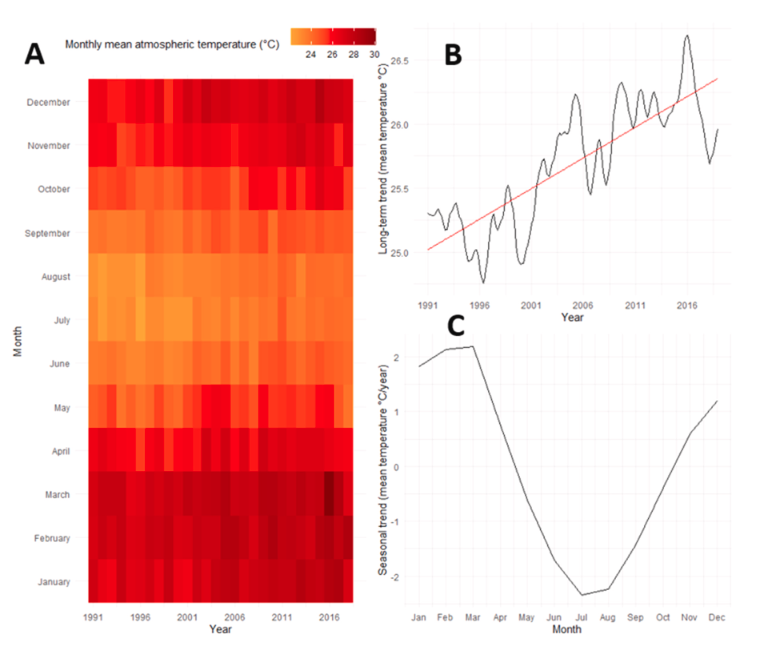
Climate change poses severe threats to coastal social-ecological systems (SES) worldwide. Recent calls recognize the importance of including Indigenous and local knowledge (ILK) in research on climate change impacts. Yet studies that have attempted to weave ILK and scientific knowledge have seldom considered the gendered nature of climate change impacts. Building on the literature on gender and climate change and knowledge pluralism, this study contributes to addressing this research gap by exploring local knowledge on climate change impacts and its relation to scientific knowledge through a gendered approach and focusing on the Western Indian Ocean region, and more specifically on Kenya. We adopted a mixed methodology combining qualitative and quantitative approaches. We found evidence of pronounced climate change impacts on coastal SES both in the scientific literature and in local reports. Our findings highlight that there is an extensive overlap between information derived from scientific and local knowledge systems. Importantly, our study revealed reports of change that were only provided by SSF communities, namely changes in coastal dynamics, a decrease in rainfall, and a decrease in the abundance of green algae. Although we found gendered variations in changes reported by SSF communities, gendered differences of climate change impacts on SSF were not detected in the reviewed literature. Overall, our results suggest that knowledge cross-fertilization generates a holistic, relational, and place-based view of climate change impacts, which may support sound and gender-inclusive adaptive policies. We conclude by suggesting key policy recommendations for climate adaptation and risk management
How do young identify plants? Using the drawing method to explore early ethnobotanical knowledge in Madagascar
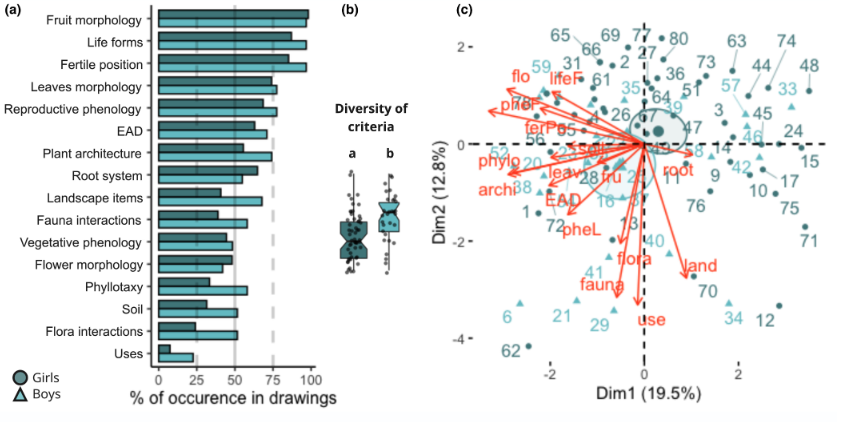
1. In small-scale societies, people learn to identify plant species during childhood. Plant recognition is an important baseline knowledge, immediately useful to avoid intoxication risk due to wrong identification. Plant recognition is the basis of other ethnobotanical knowledge essential for safeguarding biocultural diversity. However, despite many studies on folk classification, we still have a narrow understanding of the criteria locally used for species identification; the gap being even larger regarding children’s plant identification criteria.
2. Here, we study the criteria used by Betsileo children and adolescents to identify wild edible plant (WEP) species using a child-adapted method including drawings and follow-up interviews. We worked with 80 teenagers (from 12 to 17 years old; 51 girls, and 29 boys). 3. Our results suggest that teenagers use a large spectrum of visual criteria to identify plants and that these criteria match with botanical and ecological knowledge documented in the literature and herbarium vouchers. We found that 35% of the identification criteria used were non- morphological (e.g. phenology, biotic interactions), suggesting deep ecological knowledge.
4. On average, teenagers use more than nine distinct criteria per plant, which allows them to identify most plant species with a very high level of precision. The precision level of plant representation increases with age for boys, but remains constant for girls, suggesting different dynamics in plant identification knowledge acquisition.
5. We also found that boys and girls use different identification criteria: girls focus on morphological criteria while boys also incorporate ecological criteria, such as landscape features and biotic interactions, in their spectrum of identification keys.
6. Our results highlight the complexity of teenagers’ plant knowledge and the importance of the ecological context and gender in plant identification’s knowledge acquisition.
As proficient as adults: Distribution of children’s knowledge of wild edible plants in an arid environment in Madagascar
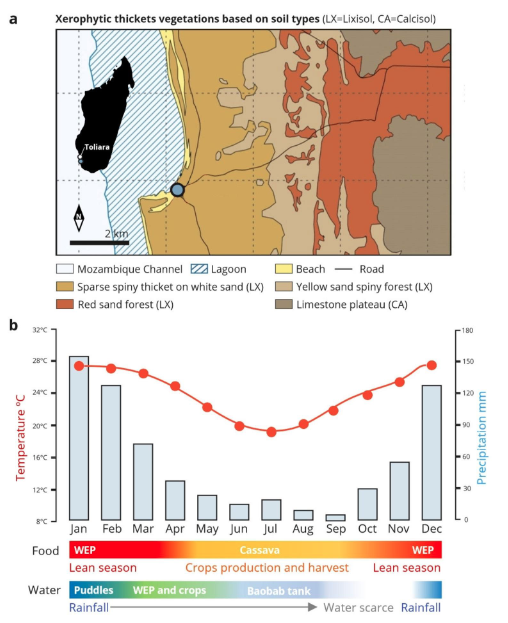
In drylands, where resources are scarce, wild edible plant (WEP) knowledge is crucial to overcome food scarcity. Understanding the distribution pattern of local ecological knowledge (LEK) about WEP and identifying knowledge holders are key steps to assessing the resilience and vulnerability of knowledge systems. However, little is known about how WEP knowledge is distributed across life stages and gender of people living in arid regions. Here, we study the distribution of WEP knowledge within a small-scale society from southwestern Madagascar, a region known for its dry climate and related food crises. We worked with Tanalana male and female children and adults using semi-structured interviews and free listings. Tanalana people display a sophisticated LEK adapted to the extreme environment in which they live, with a distinct distribution pattern regarding theoretical and practical knowledge across life stages and gender. While women and men cited similar WEP, children and adults cited different sets of WEP, suggesting they hold differentiated bodies of theoretical knowledge, however our results suggest similarity in practical knowledge across life-stage and gender. We argue that resource limitation and food scarcity might be so pervasive in the area that extensive sharing of knowledge on WEP could be an adaptation to the extremely dry environment.
Local indicators of climate change impacts described by indigenous peoples and local communities: Study protocol

In the quest to improve the understanding of climate change impacts on elements of the atmospheric, physical, and life systems, scientists are challenged by the scarcity and uneven distribution of grounded data. Through their long history of interaction with the environment, Indigenous Peoples and local communities have developed complex knowledge systems that allow them to detect impacts of climate change in the local environment. The study protocol presented here is designed 1) to inventory climate change impacts on the atmospheric, physical, and life systems based on local knowledge and 2) to test hypotheses on the global spatial, socioeconomic, and demographic distribution of reported impacts. The protocol has been developed within the framework of a project aiming to bring insights from Indigenous and local knowledge systems to climate research
“So many things have changed”: Situated understandings of climate change impacts among the Bassari, south-eastern Senegal

Mainstream discourses frame anthropogenic climate change as a biophysical apolitical problem, thus privileging Western science and silencing other worldviews. Through a case study among the Bassari, an ethnic group in South-Eastern Senegal, we assess the local, embodied, and situated understandings of climate change and the tensions that arise when the apolitical global climate change discourse interacts with situated understandings. Drawing on data from 47 semi-structured interviews and 176 surveys, we find that while the global climate change discourse has not permeated into the Bassari, they experience climate change through its many impacts on the biophysical and socio-economic systems. Results also highlight that climate is not considered the main or only driver of change, but that changes in elements of the climate system are inextricably linked with political and economic dynamics and environmental degradation. Finally, our results point toward the importance of values and supernatural forces in defining situated ways of conceptualizing, interpreting, and responding to change. By including situated worldviews in theoretical understandings of climate and environmental change, we contribute to the claims about the need to reframe how climate change is conceptualized. Our research emphasizes the importance of a relational view of climate change, which requires moving beyond understanding isolated climate change impacts towards defining climate change as a systemic problem. Building on feminist and decolonial literature, we argue for the need for more plural and democratic ways of thinking about climate change, crossing epistemological and ontological boundaries and including local communities and their knowledge and understandings.