
The gendered dimensions of small-scale fishing activities: A case study from coastal Kenya
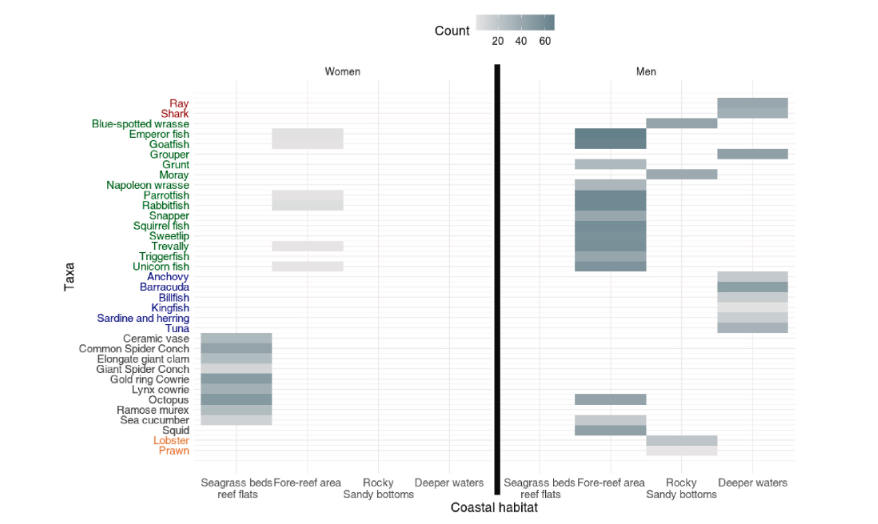
Although women contribute substantially to the small-scale fisheries sector globally, in many countries there is a severe lack of gender-disaggregated data on fishing activities. This gender data gap hampers a comprehensive understanding of small-scale fisheries dynamics with implications for fisheries management and food security. In this study, we investigate women’s and men’s engagement in small-scale fishing through a case study in coastal Kenya, a region characterized by a high dependence on fisheries for local livelihoods and nutritional needs. We applied a mixed method approach, combining participant observation, photography, semi-structured interviews on gender identities (n = 11) and gendered fishing practices (n = 28), an individual survey (n = 141), and pebble games (n = 35). Our results reveal a marked gendered division of labor across the seascape, with women mostly fishing in intertidal areas and men beyond the reef. Further, we find that women’s fishing practices are characterized by less fishing gear, less catch, a lower functional diversity of catches, less fishing effort, and less income than those of men. However, women’s catches contribute significantly to local diets, accounting for up to 50% of the fish and seafood consumed in fisherwomen-headed households. Despite women’s fishing activities appearing less productive and profitable that those of men, they are important for achieving food security in Kenyan coastal communities. Results from this study contribute to broadening our understanding of the gendered dimensions of small-scale fishing and highlight relevant information for developing gender-inclusive management strategies. We conclude by providing key recommendations for fisheries research, management, and governance.
A synthesis of women’s participation in small-scale fisheries management: why women’s voices matter

While women globally make up nearly half of the fisheries workforce, their contribution to the sector has long been overlooked with implications for fisheries management. To assess women’s participation in small-scale fisheries (SSF) management and related socio-cultural, environmental, and economic impacts, we conducted a systematic review of peer-reviewed literature (n = 124 case studies). Women had no or limited participation in more than 80% of the examined case studies reporting their participation level in SSF management. Women’s exclusion from SSF management resulted in negative outcomes, whereas their active participation was associated with various positive impacts at multiple scales. Most of the documented impacts were socio-cultural, suggesting a gap in documenting environmental impacts stemmed from women’s participation in SSF management. Importantly, most impacts reported affected the social-ecological system scale, suggesting that gender inclusion may contribute to improving the management of SSF social-ecological systems. We conclude by highlighting the need to foster gender perspectives in data collection methods used in fisheries research, in SSF management, and in ecological research on SSF social-ecological systems.
Gender matters: Women’s participation in small-scale fisheries management results in positive outcomes for both the local community and the social-ecological system
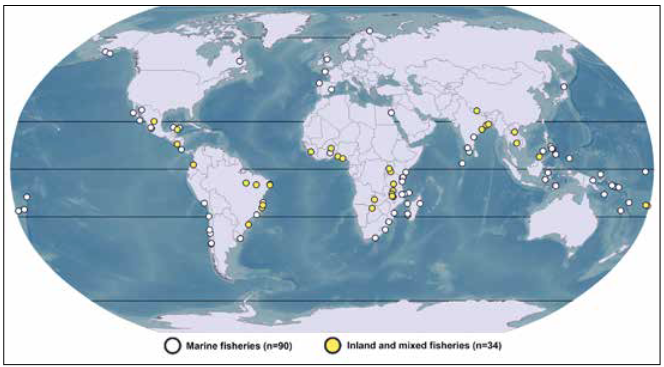
Despite women making up about 50 percent of the fisheries workforce worldwide, their contribution to the sector has long been under-estimated with implications for fisheries management and food security. This is because, in many countries, fisheries definitions are narrow and tend to focus on the production node of the value chain whereas women are mostly involved in fish processing and marketing. Gender-biased approaches in fisheries research have also contributed to mask the important role played by women in fisheries economies. In this context, this study sought to assess women’s participation in small-scale fisheries (SSF) management and the related socio-cultural, environmental, and economic impacts.
Effects of warming rate, acclimation temperature and ontogeny on the critical thermal maximum of temperate marine fish larvae

Most of the thermal tolerance studies on fish have been performed on juveniles and adults, whereas limited information is available for larvae, a stage which may have a particularly narrow range in tolerable temperatures. Moreover, previous studies on thermal limits for marine and freshwater fish larvae (53 studies reviewed here) applied a wide range of methodologies (e.g. the static or dynamic method, different exposure times), making it challenging to compare across taxa. We measured the Critical Thermal Maximum (CTmax) of Atlantic herring (Clupea harengus) and European seabass (Dicentrarchus labrax) larvae using the dynamic method (ramping assay) and assessed the effect of warming rate (0.5 to 9°C h-1) and acclimation temperature. The larvae of herring had a lower CTmax (lowest and highest values among 222 individual larvae, 13.1–27.0°C) than seabass (lowest and highest values among 90 individual larvae, 24.2–34.3°C). At faster rates of warming, larval CTmax significantly increased in herring, whereas no effect was observed in seabass. Higher acclimation temperatures led to higher CTmax in herring larvae (2.7 ± 0.9°C increase) with increases more pronounced at lower warming rates. Pre-trials testing the effects of warming rate are recommended. Our results for these two temperate marine fishes suggest using a warming rate of 3–6°C h-1: CTmax is highest in trials of relatively short duration, as has been suggested for larger fish. Additionally, time-dependent thermal tolerance was observed in herring larvae, where a difference of up to 8°C was observed in the upper thermal limit between a 0.5- or 24-h exposure to temperatures >18°C. The present study constitutes a first step towards a standard protocol for measuring thermal tolerance in larval fish.
Exploring the microzooplankton–ichthyoplankton link: a combined field and modeling study of Atlantic herring (Clupea harengus) in the Irish Sea

The microzooplankton–ichthyoplankton link remains poorly resolved in field studies due to a lack of simultaneous sampling of these predators and potential prey. This study compared the abundance, distribution and growth of larval Atlantic herring (Clupea harengus) and the abundance, biomass and composition of micro- and small mesozooplankton throughout the Irish Sea in November 2012 and 2013. In contrast to warmer months, microzooplankton biomass was highest in eastern areas, in the vicinity of the main spawning grounds of herring. Although the protozoan composition differed somewhat between years, dinoflagellates (e.g. Gymnodinium spp., Protoperidinium spp., Ceratium furca) dominated in abundance and/or biomass, similar to other temperate shelf seas in autumn/winter. Spatial differences in the protozoan community were strongly related to hydrographic characteristics (temperature, salinity). Significant relationships between the abundance of larval herring and dinoflagellates (positive) and copepodites (negative) suggested that complex grazing dynamics existed among lower trophic levels. When different, in situ size fractions of zooplankton were used as prey in a larval herring individual-based model, simulations that omitted protozooplankton under-predicted observed (biochemically-based) growth of 8–18 mm larvae. This study suggests that small planktonic organisms (20–300 µm) should be routinely surveyed to better understand factors affecting larval fish feeding, growth and survival.
Effect of zooplankton on fish larval abundance and distribution: a long-term study on North Sea herring (Clupea harengus)

During the last decade, North Sea autumn spawning herring (Clupea harengus) has gone through consecutive years of low recruitment despite high spawning-stock biomass. Although several mechanisms, such as reduced larval growth and high early larvae mortality, have been identified as co-occurring during these years, the causes behind them have not been identified. In this study, we analyse a long-term dataset of larval distribution, obtained during the International Bottom Trawl Survey, in relation to environmental conditions during winter and zooplankton abundances, obtained from the continuous plankton recorder. These analyses assessed the potential influence of these factors on the reduced survival of larval stages. Generalized additive mixed models on 30 years of data showed the abundance of Pseudocalanus sp. during winter to have a strong relationship with larval distribution and abundance, suggesting that predator–prey processes are behind the low recruitment in recent years. According to our models, the direct effect of temperature on larval abundances was less than the effect of zooplankton abundances.